





Tobramycin Eye Ointment – Uses, Benefits, Dosage, Side Effects & Buy Online
Jul 27, 2026
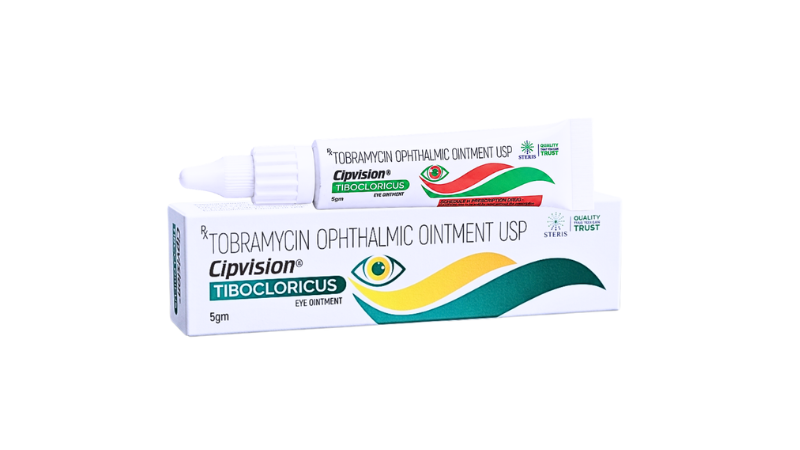
CIPVISION TIBOCLORICUS Eye Ointment contains Tobramycin, is an aminoglycoside antibiotic that treats bacterial infections. It is available as eye drops, inhalation solution, and injection, and works by preventing bacterial growth. It works by stopping bacteria from producing the proteins they need to survive, killing the infection at its source. Applied directly to the eye as a thin ribbon, it is typically used 2–4 times daily for 7–10 days, exactly as directed by an ophthalmologist. It is a prescription-only (Schedule H) medicine manufactured by Steris Healthcare, and should never be self-prescribed or shared.
What is Tobramycin Eye Ointment For?
CIPVISION TIBOCLORICUS Eye Ointment, formulated with the active ingredient Tobramycin, is an ophthalmic antibiotic ointment prescribed for treating bacterial infections affecting the eye and the eyelid margins. It belongs to the aminoglycoside class of antibiotics, a well-established group of medicines known for their strong action against a wide range of gram-negative and several gram-positive bacteria.
When bacteria invade the delicate tissues of the eye, they can cause redness, swelling, discharge, irritation, and — if left untreated — more serious complications that threaten vision. Tobramycin Eye Ointment is specifically designed to reach the site of infection directly, sit on the ocular surface for a longer duration than eye drops, and steadily release the antibiotic to eliminate the causative bacteria.
Doctors commonly prescribe CIPVISION TIBOCLORICUS for conditions such as:
- Bacterial conjunctivitis (commonly known as "pink eye")
- Blepharitis (inflammation of the eyelid margins)
- Bacterial keratitis (infection of the cornea)
- Dacryocystitis (infection of the tear sac)
- Post-operative prophylaxis after eye surgery, when advised by the treating doctor
- Corneal ulcers caused by susceptible bacterial strains
Because this is an ointment rather than a drop, it clings to the eye surface for longer, making it especially useful for nighttime application, where prolonged contact enhances antibiotic action while the person sleeps.
Why Tobramycin Eye Ointment Is Important
Eye infections may look minor at first — a bit of redness, some morning crust, mild itching — but bacterial infections of the eye can progress quickly if the wrong treatment (or no treatment) is used. Unlike viral eye infections, which usually resolve on their own, bacterial infections generally need targeted antibiotic therapy to prevent the infection from spreading to deeper eye structures.
Tobramycin Eye Ointment is important because it:
- Directly targets the bacteria responsible for the infection, rather than just masking symptoms
- Reduces the risk of complications such as corneal scarring or vision impairment from untreated bacterial keratitis
- Offers a longer contact time with the eye surface compared to drops, which is clinically useful for moderate-to-severe infections
- Helps prevent the infection from spreading to the other eye or to close contacts, especially in contagious bacterial conjunctivitis
- Provides relief from associated discomfort — burning, grittiness, and swelling — once the underlying bacterial cause is addressed
Untreated or inadequately treated bacterial eye infections are a recognised cause of preventable ocular morbidity, which is why timely, doctor-guided antibiotic therapy such as CIPVISION TIBOCLORICUS plays a meaningful role in protecting eye health.
Key Benefits of CIPVISION TIBOCLORICUS (Tobramycin Eye Ointment)
What Are the Benefits of Tobramycin Eye Ointment?
- Broad Antibacterial Coverage — Effective against many common gram-negative organisms (including Pseudomonas aeruginosa) and several gram-positive organisms implicated in ocular infections.
- Prolonged Ocular Contact Time — The ointment base allows the antibiotic to stay on the eye surface longer than drops, supporting sustained drug action, particularly useful at bedtime.
- Targeted Local Action — Because it is applied directly to the eye, it acts at the site of infection with minimal systemic absorption compared to oral antibiotics.
- Soothing Ointment Base — The lubricating base can also ease dryness, grittiness, and mild irritation associated with the infection.
- Trusted Manufacturing Standards — CIPVISION TIBOCLORICUS is manufactured by Steris Healthcare, a WHO-GMP and ISO-certified facility, ensuring consistent quality and sterility standards expected of ophthalmic preparations.
- Convenient Dosing Schedule — Typically used 2 to 4 times a day, fitting easily into a daily routine when taken as directed.
- Suitable Across Age Groups — Used in adults and, under medical supervision, in children for appropriate indications.
Mechanism of Action of Tobramycin Eye Ointment
Tobramycin belongs to the aminoglycoside class of antibiotics. Its mechanism of action centers on disrupting bacterial protein synthesis:
- Tobramycin binds irreversibly to the 30S ribosomal subunit of susceptible bacteria.
- This binding causes misreading of the bacterial genetic code (mRNA) during translation, leading to the production of faulty, non-functional proteins.
- The accumulation of these defective proteins disrupts the bacterial cell membrane's integrity.
- This ultimately results in a bactericidal effect — meaning it directly kills the bacteria rather than merely stopping their growth.
Because human cells do not have the same 30S ribosomal structure, tobramycin's action is selectively targeted toward bacterial cells, which is part of why it is considered an effective and well-tolerated topical antibiotic for ocular use when prescribed appropriately.
Indications, Efficacy and Clinical Evidence
Indications: CIPVISION TIBOCLORICUS (Tobramycin Eye Ointment) is indicated for the treatment of superficial ocular infections involving the conjunctiva and/or cornea caused by tobramycin-susceptible strains of bacteria, including certain strains of Staphylococcus, Streptococcus, Pseudomonas, Haemophilus, and E. coli species.
Efficacy: Aminoglycosides like tobramycin have long been used in ophthalmology due to their rapid bactericidal action against many common ocular pathogens, particularly Pseudomonas aeruginosa, an organism that can cause rapidly progressive and sight-threatening keratitis if untreated.
Clinical Evidence: Ophthalmic tobramycin formulations are widely referenced in clinical guidelines for bacterial conjunctivitis and keratitis management.
Side Effects of Tobramycin Eye Ointment
Most people tolerate CIPVISION TIBOCLORICUS well, but as with any medicine, side effects are possible. Common, generally mild and temporary side effects include:
- Temporary burning or stinging upon application
- Blurred vision immediately after application (due to the ointment base)
- Mild eye irritation or redness
- Itching around the eyelid
- Watering of the eyes
- Eyelid swelling (mild)
Serious Side Effects of Tobramycin Eye Ointment
Although uncommon, the following should be treated as medical emergencies and reported to a doctor immediately:
- Severe allergic reaction — swelling of the face, lips, tongue, or throat, difficulty breathing, or severe rash
- Persistent or worsening eye pain
- Significant vision changes that do not resolve shortly after application
- Signs of a new or worsening infection despite treatment (increased redness, discharge, or swelling)
- Prolonged or excessive use leading to fungal overgrowth (superinfection), particularly with extended, unsupervised use
Available Substitutes for Tobramycin Eye Ointment
| Substitute Composition | Common Use |
|---|---|
| Tobramycin + Dexamethasone Eye Ointment/Drops | Bacterial infection with associated inflammation |
| Moxifloxacin Eye Drops | Broad-spectrum bacterial conjunctivitis/keratitis |
| Ciprofloxacin Eye Ointment | Bacterial conjunctivitis, corneal ulcers |
| Gentamicin Eye Ointment | Bacterial eye infections (alternative aminoglycoside) |
| Ofloxacin Eye Drops | Bacterial conjunctivitis |
Dosage Guidelines for Tobramycin Eye Ointment
- Typical Adult Dosage: Apply a small ribbon (approximately 1–1.5 cm) of ointment into the lower eyelid pouch of the affected eye, usually 2 to 4 times a day, or as directed by the doctor.
- Duration: Commonly prescribed for 7 to 10 days, or until the doctor advises discontinuation, even if symptoms improve earlier.
- Application Technique:
- Wash hands thoroughly before application.
- Tilt the head back slightly and gently pull down the lower eyelid to form a small pocket.
- Squeeze a thin ribbon of ointment into this pocket without letting the tube tip touch the eye or eyelid.
- Close the eye gently for 1–2 minutes and roll the eyeball to help spread the ointment.
- Wipe away any excess ointment with a clean tissue.
- Wash hands again after application.
- Missed Dose: Apply as soon as remembered; if it is almost time for the next dose, skip the missed one — do not double up.
- Pediatric Use: Only under specific medical guidance and dosage adjustment by a pediatric ophthalmologist or physician.
Precautions & Warnings
- Prescription only — CIPVISION TIBOCLORICUS should be used strictly under medical supervision; do not self-medicate.
- Do not use if you have a known hypersensitivity to tobramycin or other aminoglycoside antibiotics.
- Avoid wearing contact lenses during the course of treatment unless your doctor specifically permits it.
- Do not touch the tip of the ointment tube to the eye, fingers, or any surface, to avoid contamination.
- Inform your doctor if you are pregnant, planning pregnancy, or breastfeeding before starting this medicine.
- Do not share this medicine with another person, even if they have similar symptoms.
- If using other eye medicines, maintain at least a 5–10 minute gap between applications, or as advised by your doctor.
- Discontinue and consult your doctor promptly if symptoms worsen or do not improve within the expected time frame.
- Store as per the label instructions, generally at room temperature, away from direct sunlight and out of reach of children.
- Do not use beyond the expiry date printed on the pack.
Conclusion
CIPVISION TIBOCLORICUS Eye Ointment, formulated with Tobramycin, offers a targeted, doctor-guided approach to managing bacterial infections of the eye and eyelid. By directly disrupting bacterial protein synthesis, it works to clear the infection at its source while its ointment base provides longer-lasting contact with the eye surface than conventional drops. While generally well tolerated, it remains a prescription-only medicine, and safe, effective use depends on following the exact dosage, duration, and precautions advised by an ophthalmologist. With consistent, correctly applied treatment, most bacterial eye infections respond well, helping protect both comfort and long-term eye health.
Frequently Asked Questions
1. What is Tobramycin Eye Ointment used for?
It is used to treat bacterial infections of the eye and eyelids, such as conjunctivitis, blepharitis, and bacterial keratitis, by killing the bacteria responsible for the infection.
2. What is the correct way to apply eye ointment?
Wash your hands, tilt your head back, gently pull down the lower eyelid to form a pocket, apply a thin ribbon of ointment inside it without touching the tube tip to the eye, then close your eyes gently for a minute before wiping away excess ointment.
3. Is Tobramycin a strong antibiotic?
Yes, tobramycin is a potent aminoglycoside antibiotic effective against a broad range of bacteria, including Pseudomonas aeruginosa, but its strength is exactly why it should only be used as prescribed by a doctor.
4. How long should Tobramycin be used for an eye infection?
It is typically used for 7 to 10 days, but the exact duration should always follow your doctor's specific instructions, even if symptoms improve sooner.
5. Can Tobramycin Eye Ointment be used for children? It may be prescribed for children in certain cases, but only under a doctor's or pediatric ophthalmologist's supervision with an appropriate dosage.
6. Does Tobramycin Eye Ointment cause blurred vision?
Yes, temporary blurred vision right after application is common due to the ointment's texture and usually clears within a few minutes.
7. Can I wear contact lenses while using this ointment?
It is generally advised to avoid contact lenses during treatment unless your doctor specifically says otherwise.
8. Is CIPVISION TIBOCLORICUS available without a prescription?
No, it is a Schedule H prescription medicine and should only be used under a doctor's guidance.
9. What should I do if I miss an application?
Apply it as soon as you remember, but if it is nearly time for the next dose, skip the missed one and continue your regular schedule.
10. Can Tobramycin Eye Ointment be used in both eyes?
It should only be applied to the eye(s) diagnosed with infection, as directed by your doctor; using it in an unaffected eye without medical advice is not recommended.
11. What are the common side effects of Tobramycin Eye Ointment?
Mild burning, stinging, temporary blurred vision, itching, and watering of the eyes are the most commonly reported effects.
12. Is it safe to use Tobramycin Eye Ointment during pregnancy?
You should inform your doctor if you are pregnant or breastfeeding, so they can assess whether it is appropriate for your specific situation.
13. What bacteria does Tobramycin Eye Ointment treat?
It is effective against many gram-negative bacteria, including Pseudomonas aeruginosa, and certain gram-positive bacteria commonly implicated in ocular infections.
14. Can Tobramycin Eye Ointment be used with other eye drops?
Yes, but a gap of at least 5–10 minutes between different eye medicines is generally recommended, or as advised by your doctor.
15. What happens if a bacterial eye infection is left untreated?
It can worsen, spread to deeper eye structures, cause corneal scarring, or in severe cases threaten vision, which is why timely antibiotic treatment matters.
16. How is Tobramycin Eye Ointment different from Tobramycin eye drops?
The ointment has a longer contact time with the eye surface compared to drops, making it especially useful for overnight application, while drops are often used during the day for convenience.
17. Can Tobramycin Eye Ointment be stopped once symptoms improve?
No, the full course should be completed as prescribed, even if symptoms improve early, to prevent recurrence or antibiotic resistance.
For Further More Information:
Mail Us: [email protected] or [email protected]
Call Now: +918824175417, +919982524671
Recent Post
Ceftriaxone Injection Uses in Hindi: फायदे, खुराक और सावधानियां
Olanzapine Tablet Uses in Hindi: फायदे, खुराक और साइड इफेक्ट्स
Prednisolone Acetate Ophthalmic Suspension: Uses, Benefits & Where to Buy
Teneligliptin 20 mg Uses – A Complete Guide to Type 2 Diabetes Control
CONARIS 100 (इट्राकोनाजोल कैप्सूल 100mg) उपयोग और सावधानियां हिंदी में
Ursodeoxycholic Acid Tablet Uses in Hindi | फायदे, खुराक और साइड इफेक्ट्स
Rabeprazole Gastro Resistant Tablet IP 20 mg: Uses, Benefits, Dosage & Side Effects
Duloxetine 20 mg Uses in Hindi: फायदे, नुकसान और काम करने का तरीका
Silodosin Capsules 8mg Uses in Hindi | पूरी जानकारी
Rivaroxaban 20 mg – Blood Thinner Uses, Dosage & Safety Guide